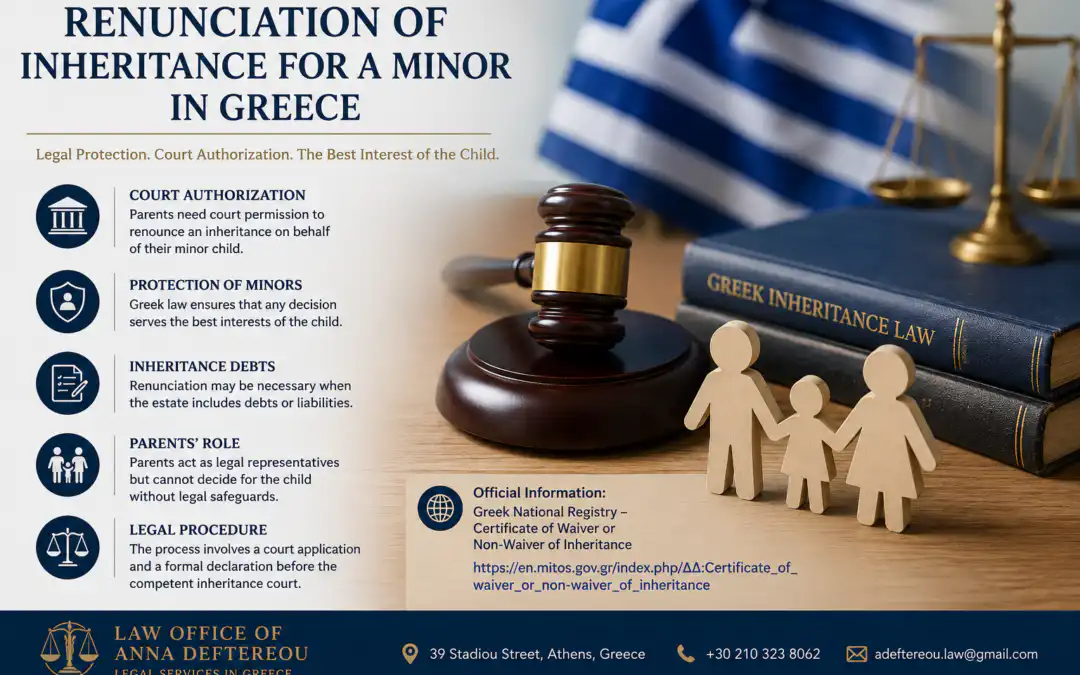
Renunciation of Inheritance for a Minor in Greece requires particular attention because a minor cannot independently decide to renounce an inheritance. Where a child becomes an heir, the applicable procedure must be carried out through the persons exercising parental responsibility or the minor’s legal representative and, where required by Greek law, with prior court authorisation.
This issue frequently arises when a parent or another relative renounces an inheritance containing debts and the inheritance subsequently passes to the next person in the order of succession, who may be a minor child.
The Law Office of Anna Deftereou in Athens provides legal assistance in Greek inheritance matters involving minor heirs, including applications for court authorisation and the subsequent inheritance procedure.
For broader inheritance assistance, visit our Greek Inheritance Lawyer page.
When Can a Minor Become an Heir in Greece?
A minor can become an heir either under a will or according to the rules of intestate succession.
In practice, an important situation arises when an adult heir renounces an inheritance.
Renunciation can change the order of succession, potentially causing the inheritance to pass to another relative. In some cases, the next person called to inherit may be the renouncing heir’s minor child.
This means that parents considering their own renunciation should examine who will subsequently be called to the inheritance.
For general information about the procedure, see How to Renounce an Inheritance in Greece.
Can Parents Renounce an Inheritance on Behalf of a Minor?
Parents cannot treat a minor’s inheritance as if it were their own.
Where an inheritance has devolved upon a minor and the parents wish to renounce it on the child’s behalf, the requirements established for the protection of the minor must be followed.
Greek law provides safeguards because renunciation removes an inheritance right belonging to the child.
Consequently, court authorisation is required before the persons exercising parental responsibility can validly proceed with the renunciation on behalf of the minor.
The purpose of this judicial control is to determine whether the proposed action serves the interests of the child.
Court Authorisation for Renunciation
The application for judicial authorisation is a central part of a Renunciation of Inheritance for a Minor in Greece.
The court is not simply asked to confirm that the parents themselves do not want the inheritance. The application must concern the minor’s legal and financial interests.
Depending on the circumstances, the case may involve evidence concerning:
- the deceased and the inheritance;
- the relationship between the minor and the deceased;
- previous renunciations by other heirs;
- how the inheritance devolved upon the minor;
- known assets of the estate;
- known debts and liabilities;
- the reasons why renunciation is considered beneficial for the child;
- supporting documentation concerning the estate.
The exact evidence required depends on the circumstances of the individual inheritance.
Why Would Parents Renounce an Inheritance for Their Child?
The most common reason is that the inheritance contains debts or liabilities that make retaining it potentially disadvantageous.
An estate can contain:
- bank loans;
- tax debts;
- debts to private parties;
- unpaid property obligations;
- business liabilities;
- other financial obligations.
However, the existence of debt should not simply be assumed.
Where possible, the financial position of the estate should be examined and the reasons supporting renunciation properly documented for the court proceedings.
Renunciation by the Parent Can Cause the Child to Become an Heir
This is one of the most important points for families to understand.
Suppose a parent is called to an inheritance but decides to renounce it because the estate contains substantial debts.
The matter does not necessarily end with the parent’s renunciation.
As a result of the applicable succession rules, the inheritance may pass to another person in the family line. This can include the parent’s child.
If that child is a minor, a separate legal procedure may then become necessary.
Therefore, before an adult completes a renunciation, it is advisable to determine who is likely to become the next heir.
Renunciation Is Not the Same as Disinheritance
The English terminology is particularly important on this subject.
Renunciation of inheritance means that a person who has already been called to an inheritance refuses that inheritance according to the procedure provided by law.
Disinheritance, by contrast, generally refers to a testator excluding or attempting to exclude someone from inheriting.
These are fundamentally different legal concepts.
For that reason, although the existing URL of this article contains the term “disinheritance,” the procedure discussed here is correctly described as renunciation of inheritance on behalf of a minor.
What Happens After Court Approval?
Obtaining court authorisation does not by itself necessarily complete the renunciation.
After the required authorisation has been obtained, the renunciation declaration must be completed according to the applicable inheritance procedure.
Greek administrative information provides that declarations of renunciation are made before the registry of the competent inheritance court.
The relevant court decision and the documents required for the inheritance must therefore be available for the subsequent procedural step.
For dedicated legal assistance with renunciation, visit our Renunciation of Inheritance Greece service page.
Which Court Is Competent?
The question of jurisdiction should be examined according to the particular procedural step.
The court dealing with an application for authorisation concerning a minor and the authority before which the subsequent inheritance declaration is made must be identified according to the applicable procedural rules and the circumstances of the case.
Official Greek administrative information confirms that a declaration of renunciation is registered with the competent inheritance court.
Applicants should therefore determine the competent court before preparing or submitting the procedure.
Documents That May Be Required
The precise documentation depends on the inheritance and the court proceedings.
Depending on the circumstances, relevant documents may include:
- death certificate;
- family status certificates;
- birth certificate of the minor;
- documentation establishing parental responsibility;
- published will, if applicable;
- certificates concerning wills;
- previous declarations or certificates of renunciation;
- documents showing how the minor became an heir;
- information concerning estate assets;
- evidence of debts or liabilities;
- other documentation supporting the court application.
Foreign documents may also require appropriate authentication and Greek translation before they can be used.
Inheritance Debts and Minor Heirs
Cases involving minors frequently arise because an inheritance is believed to contain substantial debts.
Greek law contains special protective rules for minor heirs.
The reform introduced by Law 5303/2026 expressly includes provisions concerning parental responsibility and the protection of minors where an inheritance devolves upon them.
For this reason, a minor’s legal position should not simply be treated as identical to that of an adult heir.
The applicable rules, the date on which the inheritance arose and any transitional provisions should be examined for the particular case.
The 2026 Reform of Greek Inheritance Law
Greek inheritance law underwent substantial reform through Law 5303/2026, published in May 2026.
Among other matters, the legislation addresses:
- acceptance and renunciation of inheritance;
- procedural rules concerning inheritance declarations;
- parental responsibility where an inheritance devolves upon a minor;
- protection of minor heirs.
The reform specifically replaced Article 1527 of the Greek Civil Code concerning parental liability and protection of minors in cases where an inheritance devolves upon them.
It also amended Article 1625 concerning inheritance or legacies devolving upon minors and the acts that cannot be performed on their behalf without the safeguards prescribed by law.
Therefore, older internet articles concerning minor heirs should not automatically be relied upon without checking which legal framework applies.
Deadline for Renunciation
The ordinary renunciation period under the current Greek inheritance framework is generally four months from the point at which the heir learns of the devolution of the inheritance and the reason for it.
Where the deceased had their last residence abroad, or the heir was residing abroad when the relevant period began, the period is generally one year.
Where succession is based on a will, the period does not begin before publication of the testamentary disposition.
However, cases involving minors require additional analysis because special protective rules apply.
Special Rules Concerning Minor Heirs
The deadline issue for minors should not simply be treated in exactly the same way as for an adult heir.
Greek legislation has provided special protection concerning minors and inheritance renunciation.
The Greek Independent Authority for Public Revenue (AADE) issued detailed guidance in 2025 concerning Article 35 of Law 4786/2021 and the renunciation period for persons who were minors when the inheritance devolved upon them.
According to that guidance, under the framework examined there, heirs who were minors when the inheritance devolved upon them could retain a right of renunciation up to one year after reaching adulthood, provided that acceptance or another event terminating that right had not occurred.
Because Greek inheritance law was subsequently reformed in 2026, the applicable provisions and transitional rules should be checked according to the date of death, the date the inheritance devolved upon the minor and the particular circumstances.
This is preferable to assuming that a general deadline found online automatically applies to every minor heir.
Can Parents Simply Wait Until the Child Turns 18?
This should not be treated as a general strategy without examining the particular case.
The existence of special protection for minors does not mean that parents should automatically leave an inheritance matter unresolved until adulthood.
There may be estate debts, tax matters, property issues, actions by creditors or other circumstances requiring attention.
The legal position should therefore be examined when the family becomes aware that the minor has been called to the inheritance.
What If the Minor Lives Outside Greece?
Cases involving a minor living abroad can require additional procedural preparation.
Relevant issues may include:
- residence of the child and parents;
- parental responsibility;
- foreign birth and family-status documents;
- authentication or Apostille;
- official Greek translations;
- representation in Greece;
- the location of the deceased and estate;
- applicable procedural jurisdiction.
The international element may also be relevant when examining inheritance deadlines.
Documents should therefore be prepared according to the specific Greek procedure rather than assuming that a foreign court or foreign document automatically resolves the Greek inheritance matter.
Foreign Birth Certificates and Family Documents
Where a child was born abroad, foreign civil-status documents may be necessary to establish identity, parentage and parental responsibility.
Depending on the issuing country, documents may require an Apostille, another form of legalisation or an official translation into Greek.
Where the child or parent is a Greek citizen, questions concerning registration of foreign civil-status events in Greece may also arise.
The exact documentation should be identified before arranging translations or authentication.
What If Both Parents Exercise Parental Responsibility?
The family circumstances and the persons legally exercising parental responsibility should be identified before filing the application.
Where both parents exercise parental responsibility, the procedure should be prepared accordingly.
Different circumstances can arise where:
- the parents are divorced;
- one parent has sole parental responsibility for the relevant matters;
- one parent is deceased;
- a guardian has been appointed;
- the minor is subject to another protective arrangement.
The legal authority of the person acting for the child must therefore be established.
What If There Is a Conflict of Interest?
Inheritance cases can sometimes create a conflict between the interests of a parent and those of the minor.
For example, the parent and child may both have inheritance rights in the same estate or their respective legal positions may not be identical.
Where a conflict exists, additional rules concerning representation of the minor may become relevant.
The issue should be identified before the court application or inheritance declaration is prepared.
Can a Minor Accept an Inheritance?
A minor can become an heir, but Greek law provides special safeguards concerning the administration and legal consequences of inheritance during minority.
The appropriate course depends on the estate and applicable protective provisions.
Parents should therefore not view the choice as simply:
“accept the inheritance” or “renounce the inheritance.”
The nature of the assets, liabilities and protections available to the minor should be examined first.
For general information about acceptance, see our guide to Acceptance of Inheritance in Greece.
Certificate of Renunciation or Non-Renunciation
A certificate may subsequently be required to establish whether an inheritance has been renounced.
The Greek National Registry of Administrative Public Services provides an official procedure for obtaining a certificate concerning renunciation or non-renunciation of inheritance.
The procedure was updated in July/August 2026 and provides for digital processing in specified courts and circumstances.
Official information is available here:
Greek National Registry – Certificate of Waiver or Non-Waiver of Inheritance
Why Early Legal Review Is Important
A minor inheritance case can involve several interconnected issues:
- succession order;
- previous renunciations;
- inheritance deadlines;
- court authorisation;
- parental responsibility;
- estate debts;
- foreign documents;
- procedural representation;
- subsequent renunciation declaration.
An error at one stage can complicate later stages of the procedure.
For this reason, it is useful to establish the minor’s legal position as soon as the family becomes aware that the child may have become an heir.
Frequently Asked Questions
Can a minor renounce an inheritance in Greece?
A minor cannot independently make a renunciation declaration. The procedure must be undertaken through the persons legally authorised to represent the child and according to the safeguards established by Greek law.
Do parents need court permission?
Where parents seek to renounce an inheritance on behalf of their minor child, prior judicial authorisation is required under the applicable protective framework. Greek court guidance likewise states that persons exercising parental responsibility must produce the court decision authorising the renunciation.
Why might a child inherit after a parent renounces?
Renunciation can change the order of succession. Depending on the family structure and applicable succession rules, another relative—including a child—may subsequently be called to inherit.
Does the parent’s renunciation automatically cover the child?
No. A parent’s renunciation should not be treated as a renunciation on behalf of their minor child.
What if the inheritance contains debts?
The liabilities of the estate should be examined together with the special legal protections applicable to minor heirs. If renunciation is considered appropriate, the required court and inheritance procedures must be followed.
Is “disinheritance of a minor” the correct term?
No. In this context, the correct English concept is renunciation of inheritance for/on behalf of a minor. “Disinheritance” generally refers to excluding someone from inheritance and describes a different legal concept.
Can the minor renounce after turning 18?
Special rules have existed protecting persons who were minors when an inheritance devolved upon them, including rules concerning the period following adulthood. Because of the 2026 inheritance reform and transitional provisions, the specific dates and applicable legal framework should be examined before relying on a general deadline.
Can the procedure be handled if the family lives abroad?
Potentially, yes, but issues concerning jurisdiction, parental responsibility, foreign documents, authorisation and representation must be examined according to the individual case.
Legal Assistance for Renunciation of Inheritance for a Minor in Greece
The Law Office of Anna Deftereou provides legal assistance concerning inheritance matters involving minors in Greece.
Assistance may include examination of the order of succession, previous renunciations, inheritance liabilities, preparation of the application for judicial authorisation and the subsequent inheritance procedure.
For dedicated assistance with inheritance renunciation, visit Renunciation of Inheritance Greece.
For broader inheritance matters, visit our Greek Inheritance Lawyer page.
For legal assistance concerning Renunciation of Inheritance for a Minor in Greece, contact our law office in Athens.
Official information concerning inheritance renunciation certificates is available through the Greek National Registry of Administrative Public Services
Law Office of Anna Deftereou
39 Stadiou Street, Athens, Greece
Tel.: +30 210 323 8062
Email: adeftereou.law@gmail.com